The sacred land of Dhar has long carried the memory of an extraordinary cultural institution: the Bhojshala–Kamal Maula complex. For centuries, this has been more than a disputed site; it has been a living intersection of Indian learning, art, architecture and civilizational self-awareness. Today—when archaeological surveys, structural evidence, and archival records align with remarkable clarity—the moment we witness is not merely judicial or administrative. It is, in the deepest sense, a “Festival of Victory”: A victory not of sentiment, but of evidence. Not of one community, but of historical truth.
1. Architecture: When Stones Begin to Speak
The architectural grammar of the complex speaks with unambiguous eloquence.
A. Original Layout: A Temple-Based Structure
• The plinth reveals the triratha–pancharatha plan typical of the Paramāra period.
• The proportions of the pillars, the sculptural detailing, and the visual balance correspond to the era of Raja Bhoj.
• Motifs such as lotuses, kalashas, floral creepers, and ghantikas reflect classical Hindu temple artistry.
B. Signs of the Goddess of Learning
• Multiple inscriptions contain names like Vagdevī, Vagdevi Peeth, and Saraswati Mandir.
• British-era photographic records (1903) document fragments of a Saraswati idol, unmistakably belonging to a Hindu shrine dedicated to the deity of knowledge.
C. Medieval Reuse of Temple Material
• Broken pillars, lattices and brackets from the ancient temple were reused in constructing the later mosque—consistent with established medieval reuse patterns across the subcontinent.
Here, architecture does not merely suggest; it testifies.
2. Archival Evidence: The Voice of History Itself
For centuries, chroniclers, travellers and scholars have recorded the nature of this complex.
1305–1511 CETexts like Tarikh-i-Firuz Shahi mention the site as a madrasa, but acknowledge an earlier academic and temple-like institution.
1598 – Abul Fazl in the Ain-i-AkbariAbul Fazl writes that the location was originally an ancient seat of learning before being used for later Islamic educational purposes.
British Records, 1850–1904Across 14 official reports, the site is uniformly described as the “Temple of Saraswati / College of Raja Bhoj.” The 1903 Archaeological Survey notes clearly: “the original Hindu sculptural remains are still visible on site.”
This is not revision of history— this is confirmation of what history has long recorded.
3. Judicial Turning Point: The Core of the Debate
The recent legal proceedings revolve around three fundamental questions:
1. What was the original structure?
2. Does later usage create permanent title rights?
3. Can scientific archaeological evidence help determine historical ownership?
Hindu Side’s Position
• The complex was originally a temple and centre of learning built under Raja Bhoj.
• Architectural and epigraphic evidence overwhelmingly supports this.Muslim Side’s Position
• The site functioned as a mosque from the 13th–14th century onward.
• Therefore, religious rights should follow historical practice.
The Court’s Core Inquiry
The judiciary is now primarily focused on the scientific findings of the Archaeological Survey, which confirm:
• The base structure is fully aligned with Hindu temple architecture.
• Pillars, mouldings and carvings match the Paramāra temple tradition.
• All excavated remains belong to a pre-existing temple complex.
With this, the discourse entered a new, decisive phase— the phase we call the “Festival of Victory.”
4. The Festival of Victory: A Cultural and Civilizational Reflection
A. Whose Victory Is This?
Not that of a community over another, but of truth over conjecture and evidence over assumption.
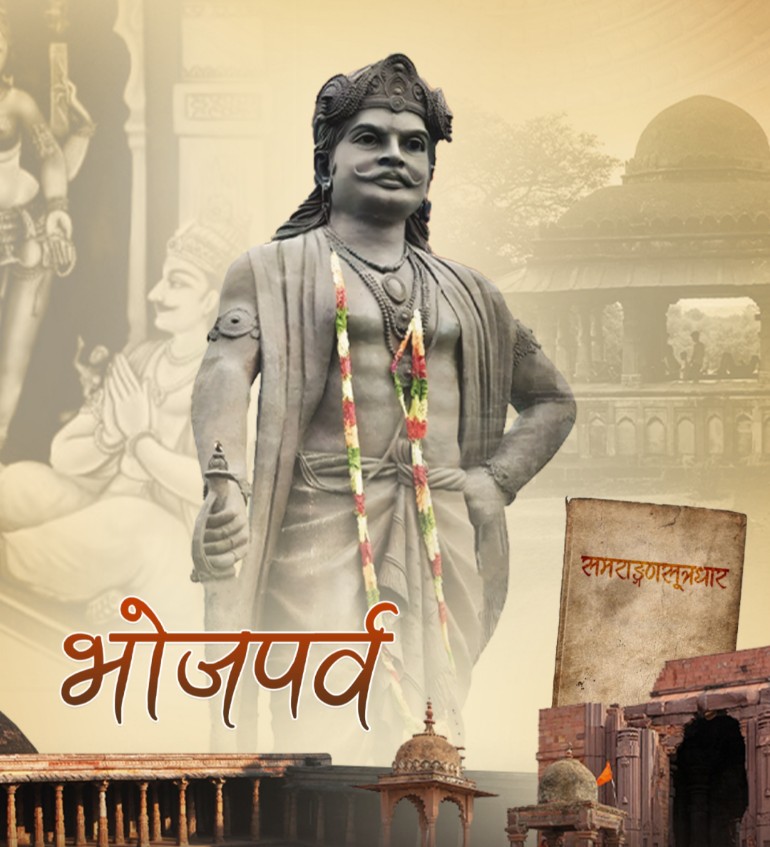
B. Revival of the Bhojshala LegacyIn the era of Raja Bhoj, this was a flourishing seat of learning where:
• Grammar, logic, poetry, mathematics
• Ayurveda, astronomy, and philosophywere taught in an atmosphere of luminous intellectual energy. The Goddess Saraswati was not merely worshipped; She was lived as the principle of knowledge itself.
C. A Convergence of Patience, Scholarship and TruthFor over 120 years, local communities, scholars and historians sought clarity. Now, scientific evidence has given legitimacy to cultural memory, and judicial scrutiny has given direction to historical understanding.
5. Not the Rewriting of History—The Re-reading of Truth
A civilization must know what its knowledge-centres once stood for. Only then can it reclaim its intellectual continuity. The Bhojshala is not a political battleground; it is an academic monument, a civilizational archive, a spiritual signature of Indian knowledge traditions. Today, when architecture, epigraphy, archaeology and jurisprudence stand in a single harmonious line, the moment becomes larger than a verdict. It becomes a remembrance of India’s cultural self.
Final Words — Why This Moment Is Truly a “Festival of Victory”Because here:
• Evidence triumphs over emotion.
• Archaeological truth triumphs over contested narratives.
• Memory triumphs over erasure.
• And India rediscovers a luminous chapter of its civilizational soul.The Bhojshala seems to speak again: “I am what Raja Bhoj established me to be.”
By Kailash Chandra